


 Index
Index
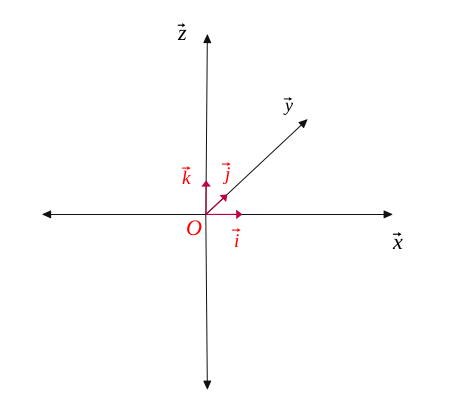
Let be \((O, \overrightarrow{i}, \overrightarrow{j}, \overrightarrow{k})\) an orthonormal coordinate system in space.
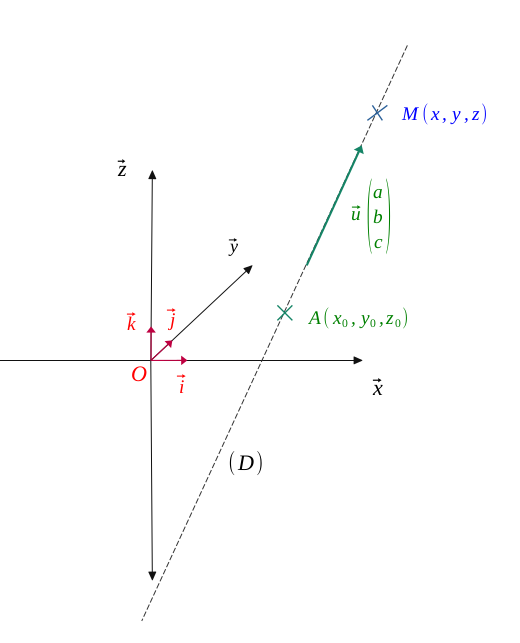
The parametric equation of a straight line \(\mathcal{D}\) in space, passing through a point \(A\bigl(x_0; y_0; z_0\bigr)\) and directed by a vector \(\vec{u}\begin{pmatrix} a\\ b \\c \end{pmatrix} \) (with \(a, b, c \) all three non-zero) is:
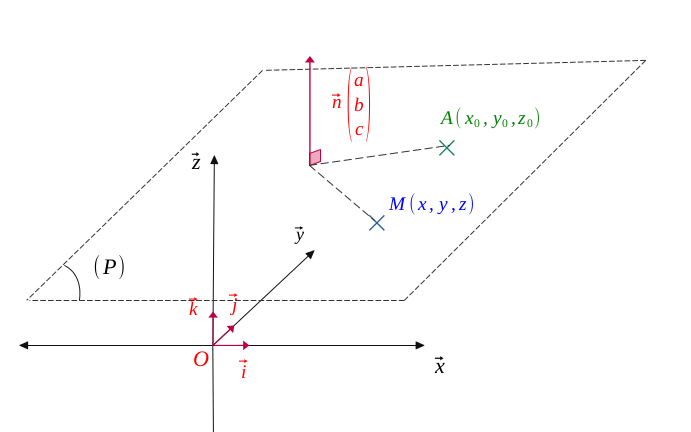
The equation of a place \((\mathcal{P})\) in space, passing through a point \(A\bigl(x_0; y_0; z_0\bigr)\) and orthogonal to a vector \(\vec{n}\begin{pmatrix} a\\ b \\c \end{pmatrix}\) (with \(a, b, c \) all three non-zero) is:
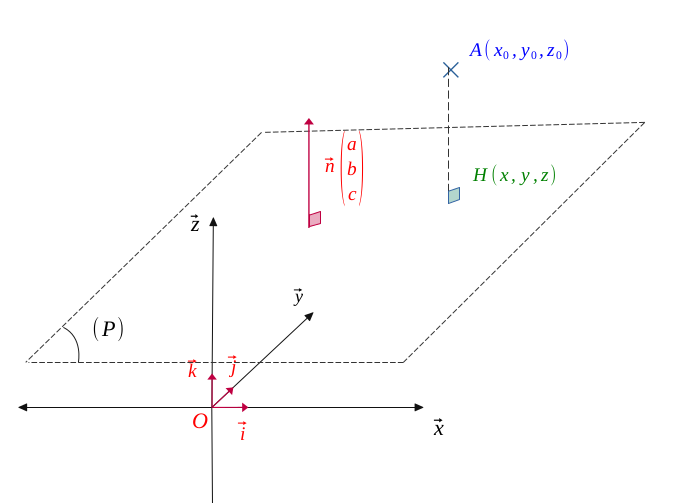
Let \(\mathcal{P}\) be a plan orthogonal to a vector \(\vec{n}\begin{pmatrix} a\\ b \\c \end{pmatrix}\) (with \(a, b, c \) all three non-zero), having as equation:
The distance from a point \(A\bigl(x_0; y_0; z_0\bigr)\) in relation to this plan \((\mathcal{P})\) orthogonally projecting on this plan at point \(H\bigl(x; y; z\bigr)\) is worth:
The projection of a vector \(\vec{u}\) on a plan \(\mathcal{P}\) orthogonal to a vector \(\vec{n}\) is worth:

The projection of a sum of vectors in a plan is the sum of each vector's projection
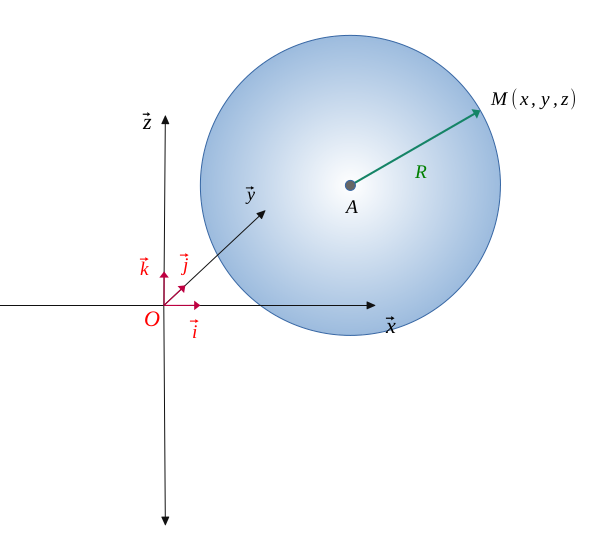
The sphere \((\mathcal{S})\) having a radius \(R\) and centered at point \(A\bigl(x_0; y_0; z_0\bigr)\) has for equation in space:
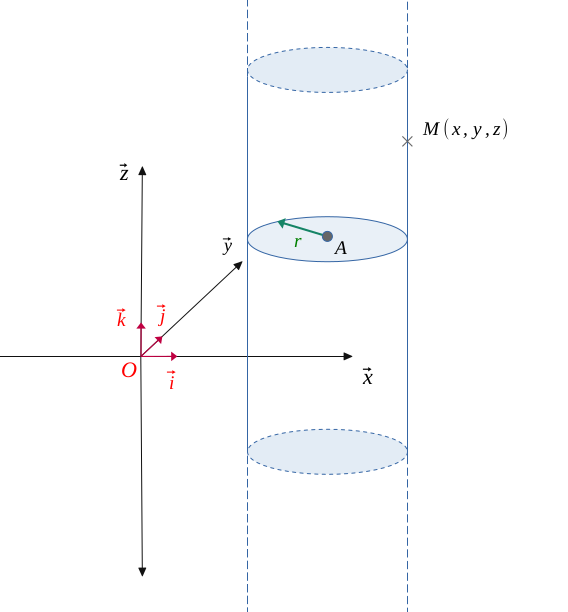
The cylinder\((\mathcal{C})\) having a radius \(r\) and centered at point \(A\bigl(x_0; y_0; z_0\bigr)\) has for equation in space:
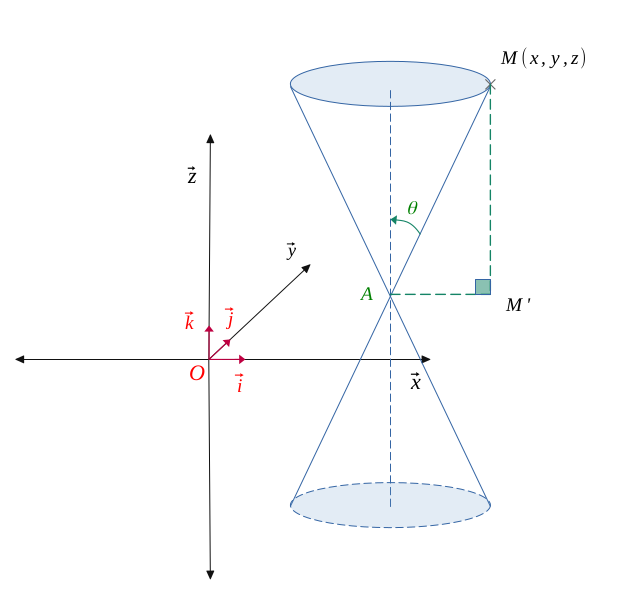
The cone \((\mathcal{C})\) having a half-angle \( \theta\), and centered at point \(A\bigl(x_0; y_0; z_0\bigr)\) has for equation in space:
-
Longitude-latitude coordinates
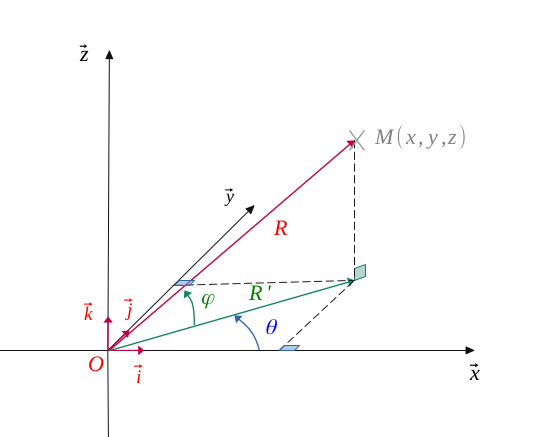 $$ \Biggl \{ \begin{gather*} x = R \ \cos(\varphi) \ \cos(\theta) \\ y = R \ \cos(\varphi) \ \sin(\theta) \\ z = R \ \sin(\varphi) \end{gather*} \qquad (\theta : longitude- \varphi : latitude) $$$$\text{with } \left \{ \begin{gather*} R =\sqrt{x^2 +y^2 +z^2 } \\ \theta = \operatorname{Arctan} \left( \frac{y}{x} \right) \\ \varphi = \operatorname{Arcsin} \left( \frac{z}{R} \right) \end{gather*} \right \}$$
 -
Longitude-colatitude coordinates
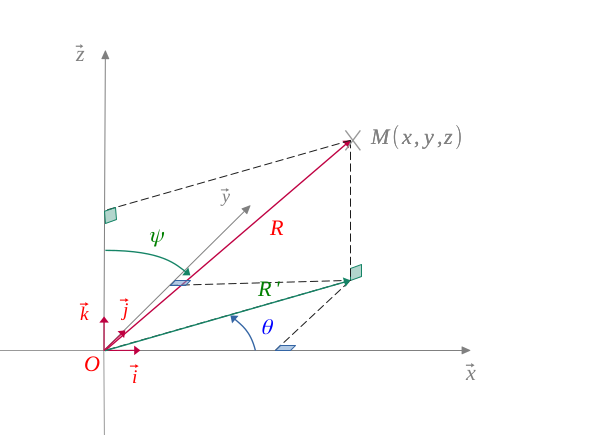 $$ \Biggl \{ \begin{gather*} x = R \ \sin(\psi) \ \cos(\theta) \\ y = R \ \sin(\psi) \ \sin(\theta) \\ z = R \ \cos(\psi) \end{gather*} \qquad (\theta : longitude- \psi : colatitude) $$$$\text{with } \left \{ \begin{gather*} R =\sqrt{x^2 +y^2 +z^2 } \\ \theta = \operatorname{Arctan} \left( \frac{y}{x} \right) \\ \psi = \operatorname{Arccos} \left( \frac{z}{R} \right) \end{gather*} \right \}$$
Lines and plans
Parametric equation of a straight line
Let \((\mathcal{D})\) be a straight line in space, passing through a point \(A\bigl(x_0; y_0; z_0\bigr)\) and directed by a vector \(\vec{u}\begin{pmatrix} a\\ b \\c \end{pmatrix} \) (with \((a, b, c) \in \hspace{0.04em} \mathbb{R}^3 \) three real numbers which are non-zero simultaneously).
As \(M \in \mathcal{D}\), so the vectors \(\vec{u}\) and \(\overrightarrow{AM}\) are collinear. Thus:
The parametric equation of a straight line \(\mathcal{D}\) in space, passing through a point \(A\bigl(x_0; y_0; z_0\bigr)\) and directed by a vector \(\vec{u}\begin{pmatrix} a\\ b \\c \end{pmatrix} \) (with \((a, b, c) \in \hspace{0.04em} \mathbb{R}^3 \) three real numbers which are non-zero simultaneously) is:
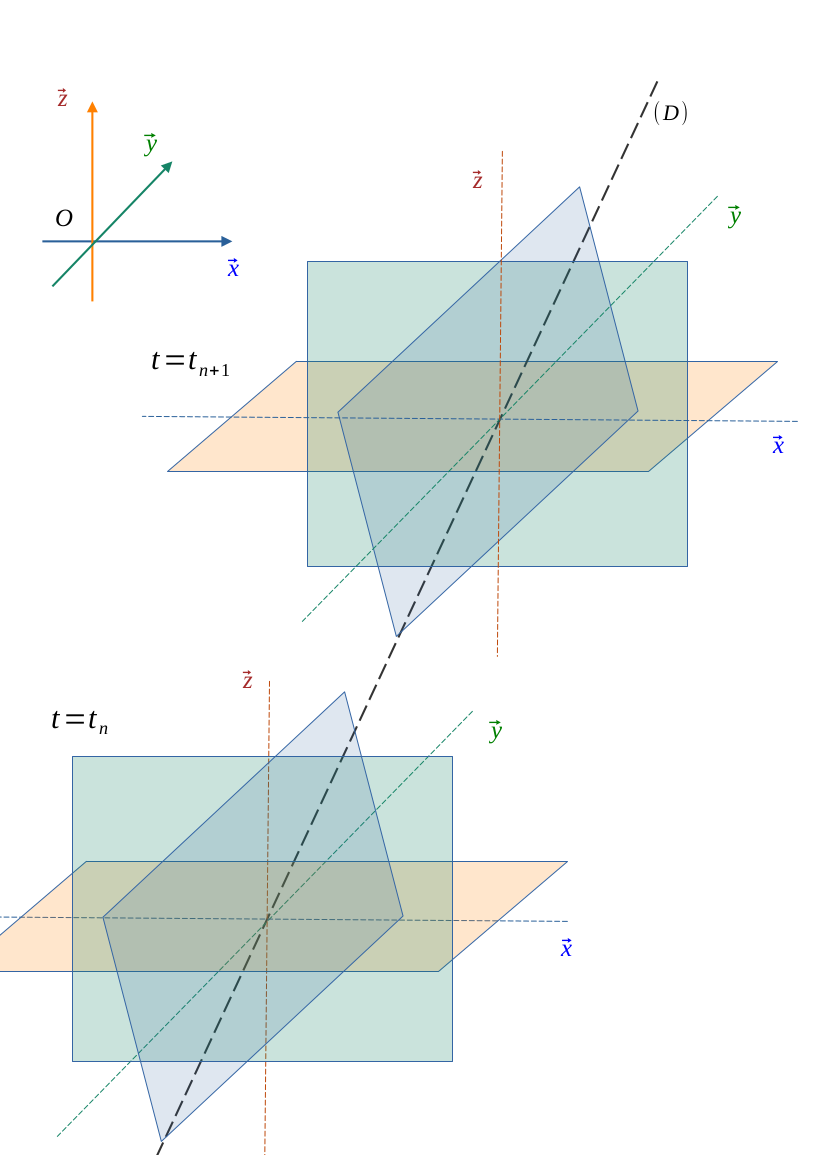
The parameter \(t\) is a free parameter that can take any value.
In fact, the line \((\mathcal{D})\) extending to infinity, we obtain a formation of this latter by varying \(t\), leading to the intersection of three plans corresponding respectively to the three equations; which forms a series of points in space.
Equation of a plan
Let \((\mathcal{P})\) be a plan in space, passing through a point \(A\bigl(x_0; y_0; z_0\bigr)\) and orthogonal to a vector \(\vec{n}\begin{pmatrix} a\\ b \\c \end{pmatrix}\) (with \((a, b, c) \in \hspace{0.04em} \mathbb{R}^3 \) three real numbers which are non-zero simultaneously).
So, any point \(M\bigl(x; y; z \bigr)\) belonging to this plan is orthogonal to \(\vec{n}\).
Two orthogonal vectors have their scalar product worthing zero.
The equation of a place \((\mathcal{P})\) in space, passing through a point \(A\bigl(x_0; y_0; z_0\bigr)\) and orthogonal to a vector \(\vec{n}\begin{pmatrix} a\\ b \\c \end{pmatrix}\) is:
Distance from a point to a plan
Let \((\mathcal{P})\) be a plan in space, orthogonal to a vector \(\vec{n}\begin{pmatrix} a\\ b \\c \end{pmatrix}\)(with \((a, b, c) \in \hspace{0.04em} \mathbb{R}^3 \) three real numbers which are non-zero simultaneously).
Let \(A\bigl(x_0; y_0; z_0\bigr)\) be a point orthogonally projecting on \((\mathcal{P})\) at point \(H\bigl(x; y; z\bigr)\).
We are trying to estimate the distance \(AH\), shortest distance from the point \(A\) to the plan \((\mathcal{P})\).
By the definition of the scalar product , we do have:
On the other hand, with the calculation of the scalar product by the coordinates product , we do have:
Given that \((1)\) and \((2)\) are equal, being the smae scalar product , we now have:
Calculant une distance, on peut passer en valeur absolue :
The distance from a point \(A\bigl(x_0; y_0; z_0\bigr)\) in relation to this plan \((\mathcal{P})\) orthogonally projecting on this plan at point \(H\bigl(x; y; z\bigr)\) is worth:
Projection of a vector on a plan
Let \((\mathcal{P})\) be a plan of normal vector \(\vec{n}\), and a vector \(\vec{u}\) on-zero and non-collinear to this plan.
We know that if we perform a vectorial projection of a vector \(\vec{u}\) on a vector \(\vec{v}\), we do have:

So, if we project the vector \(\vec{u}\) onto the vector \(\vec{n}\), we obtain a resulting vector \(\vec{n'}\):
So, as \(\vec{n'}\) is the projection of \(\vec{u}\) onto \(\vec{n}\), we now have:
Now, combining \((1)\) and \((2)\) gives us:
And finally,
The projection of a vector \(\vec{u}\) on a plan \(\mathcal{P}\) orthogonal to a vector \(\vec{n}\) is worth:
Projection of a sum of vectors upon a plan
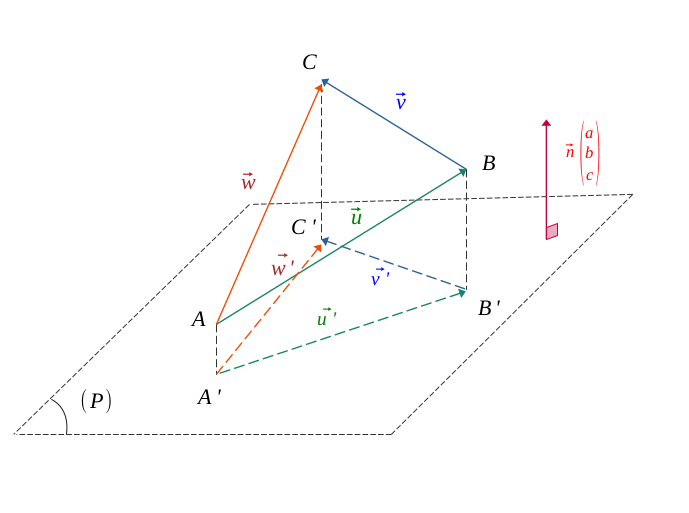
Let \((\mathcal{P})\) be a plan having as normal vector \(\vec{n}\begin{pmatrix} a\\ b \\c \end{pmatrix}\), and two non-null vectors being non-collinear to this plan, \(\vec{u}\begin{pmatrix} x_1\\ y_1 \\z_1 \end{pmatrix}\) and \(\vec{v}\begin{pmatrix} x_2\\ y_2 \\z_2\end{pmatrix}\).
Let us call \(\vec{u'}\) and \(\vec{v'}\) the respective projections of the two vectors \(\vec{u}\) and \(\vec{v}\) upon this plan.
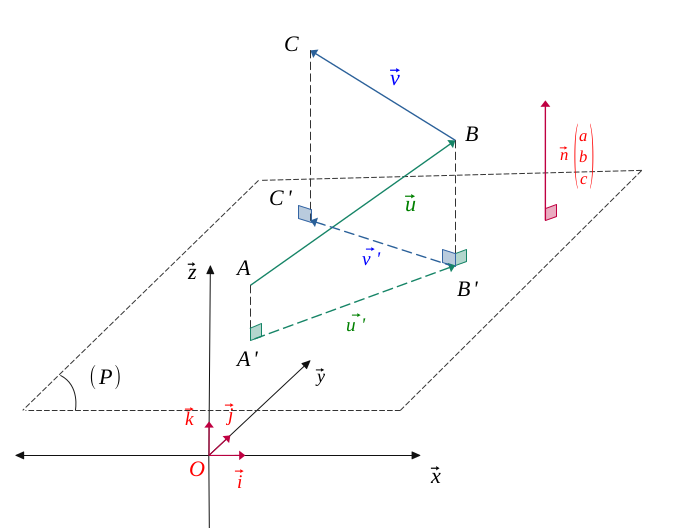
For the sake of simplicity, we placed the points \(A, B, C\) as well as their respective projection \(A', B', C'\).
Now, let \(\vec{w} = \vec{u} + \vec{v}\), the sum of vectors \(\vec{u}\) and \(\vec{v}\), and the vector \(\vec{w'}\) being the projection of \( \vec{w}\) on this plan.
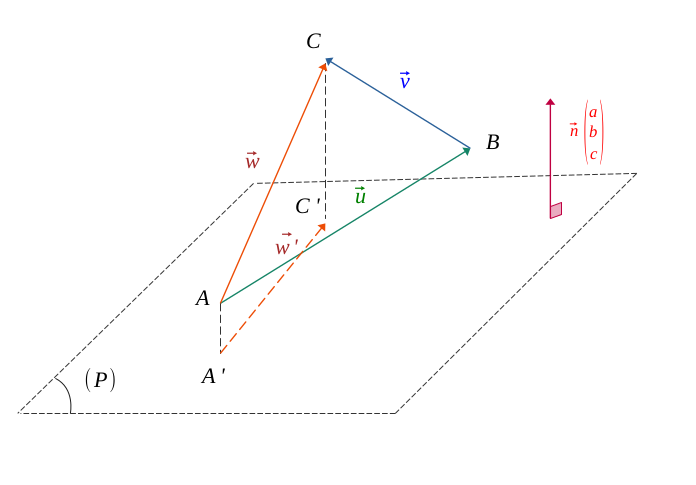
In the previous point, we saw that the vectorial projection \(\vec{u'}\) of a vector \(\vec{u}\) onto a plan \(\mathcal{P}\) of normal vector \(\vec{n}\) is worth:
We then have the following two expressions:
By adding the two expressions together, we have:
So, we notice that:
Therefore we can say that:
The projection of a sum of vectors in a plan is the sum of each vector's projection
Geometrical figures
Equation of a sphere
Let \((\mathcal{S})\) be a sphere having a radius \(R\) and centered at point \(A\bigl(x_0; y_0; z_0\bigr)\).
On this sphere, every point every point \(M\bigl(x; y; z \bigr)\) is equidistant from the point \(A\), which is worth the length of the radius \(R\).
We know that using the the Pythagorean theorem , that the distance \( AB\) in a three-dimensional space is worth:
So,
The sphere \((\mathcal{S})\) of radius \(R\) and centered at point \(A\bigl(x_0; y_0; z_0\bigr)\) has for equation in space:
Equation of a cylinder
Let \((\mathcal{C})\) be a vertical cylinder of radius \(r\) and centered at point \(A\bigl(x_0; y_0; z_0\bigr)\).
In the plan \((O, \overrightarrow{i}, \overrightarrow{j})\), the cylinder describes a circle.
We know that using the the Pythagorean theorem , that the distance \( AB\) in a plan is worth:
We then have,
The vertical axis \(z\) can take any value, so it is a free variable.
The cylinder \((\mathcal{C})\) having a radius \(r\) and centered at point \(A\bigl(x_0; y_0; z_0\bigr)\) has for equation in space:
Equation of a cone
Let \((\mathcal{C})\) a vertical cone have as half-angle \( \theta\), and centered at point \(A\bigl(x_0; y_0; z_0\bigr)\).
In the figure below, we can see that:
The cone \((\mathcal{C})\) have as half-angle \( \theta\), and centered at point \(A\bigl(x_0; y_0; z_0\bigr)\) \(A\bigl(x_0; y_0; z_0\bigr)\) has for equation in space:
Coordinates system
From cartesian to spherical coordinates
In some cases, it can be useful to use spherical coordinates (in two dimensions : polar coordinates), especially when working with spheres.
-
Longitude-latitude coordinates
In a usual orthonormal reference frame in space \((O, \overrightarrow{i}, \overrightarrow{j}, \overrightarrow{k})\), we represented a point \(M\bigl(x; y; z \bigr)\).
Let \(R\) representing the distance from this point to the origin and \(R'\) its projection on the horizontal plan \((O, \overrightarrow{i}, \overrightarrow{j})\).
Likewise, we called \(\theta\) the angle formed by the abscissa axis \((O, \overrightarrow{i})\) and \(R'\), and also \(\varphi\) the angle formed \(R'\) and \(R\).
$$ \Biggl \{ \begin{gather*} \theta = (\overrightarrow{Ox}, \overrightarrow{R'}) \\ \varphi= (\overrightarrow{R'}, \overrightarrow{R})\end{gather*} $$In the following figure, we have represented the point \(M'\), projection of point \(M\) on the horizontal plan \((O, \overrightarrow{i}, \overrightarrow{j})\).
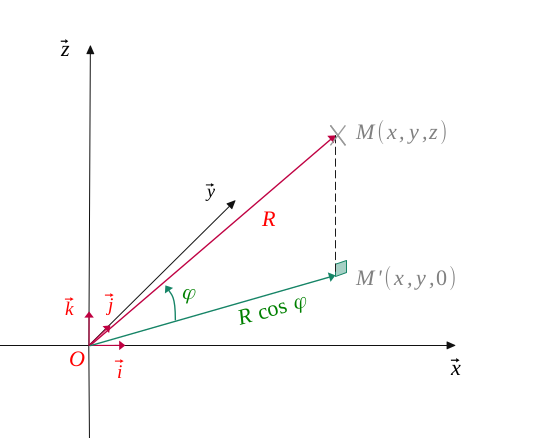
With the classic trigonometry rules, we easily see that:
$$ \Biggl \{ \begin{gather*} z = R \ \sin(\varphi) \\ R' = R \ \cos(\varphi) \end{gather*} $$Now, working with a front view of the horizontal plan \((O, \overrightarrow{i}, \overrightarrow{j})\), we can calculate the coordinates corresponding to \(x\) and \(y\).
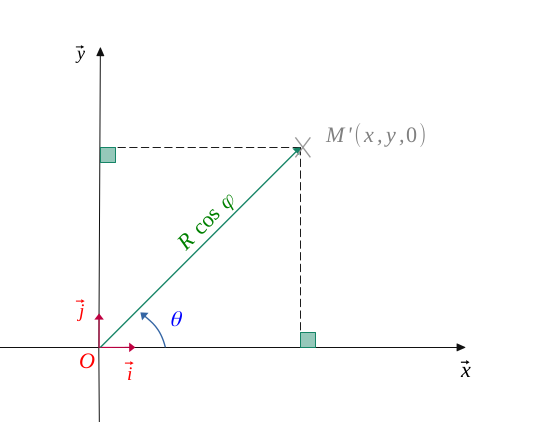
We do have :
$$ \Biggl \{ \begin{gather*} x = R \ \cos(\varphi) \ \cos(\theta) \\ y = R \ \cos(\varphi) \ \sin(\theta) \end{gather*} $$Finally, the distance \(R\) is easily calculated from cartesian coordinates \((x; y; z)\):
$$R =\sqrt{x^2 +y^2 +z^2 }$$As well, we obtain both angles \(\theta\) and \(\varphi\) by:
$$ \Biggl \{ \begin{gather*} \theta = \operatorname{Arctan} \left( \frac{y}{x} \right) \\ \varphi = \operatorname{Arcsin} \left( \frac{z}{R} \right) \end{gather*} $$So,
$$ \Biggl \{ \begin{gather*} x = R \ \cos(\varphi) \ \cos(\theta) \\ y = R \ \cos(\varphi) \ \sin(\theta) \\ z = R \ \sin(\varphi) \end{gather*} \qquad (\theta : longitude- \varphi : latitude) $$$$\text{with } \left \{ \begin{gather*} R =\sqrt{x^2 +y^2 +z^2 } \\ \theta = \operatorname{Arctan} \left( \frac{y}{x} \right) \\ \varphi = \operatorname{Arcsin} \left( \frac{z}{R} \right) \end{gather*} \right \}$$ -
Longitude-colatitude coordinates
here is another way to represent spherical coordinates; we can use colatitude instead of latitude.
We then have a new angle \(\psi\) which starts from the vertical axis \(\overrightarrow{Oz}\) towards \(R\) in the antitrigonometric direction.
$$ \Biggl \{ \begin{gather*} \theta = (\overrightarrow{Ox}, \overrightarrow{R'}) \\ \varphi= (\overrightarrow{Oz}, \overrightarrow{R})\end{gather*} $$Which gives us, applying the same reasoning:
$$ \Biggl \{ \begin{gather*} x = R \ \sin(\psi) \ \cos(\theta) \\ y = R \ \sin(\psi) \ \sin(\theta) \\ z = R \ \cos(\psi) \end{gather*} \qquad (\theta : longitude- \psi : colatitude) $$$$\text{with } \left \{ \begin{gather*} R =\sqrt{x^2 +y^2 +z^2 } \\ \theta = \operatorname{Arctan} \left( \frac{y}{x} \right) \\ \psi = \operatorname{Arccos} \left( \frac{z}{R} \right) \end{gather*} \right \}$$
Examples
-
Intersection between two plans\(: \mathcal{P} \cap \mathcal{P}' \)
Let us find the intersection \((\mathcal{P} \cap \mathcal{P}') \) between the two plans \((\mathcal{P}) \) and \((\mathcal{P}') \).
$$ (\mathcal{S}) \ \Biggl \{ \begin{gather*} \ \ 3x \ - \ y \ + z \hspace{1.8em}= 0 \qquad (\mathcal{P}) \\ -2x +2y + z + 1 = 0 \qquad (\mathcal{P}') \end{gather*} $$We scale the system \((\mathcal{S})\) performing the linear combination \( 2(\mathcal{P}) \) + \( 3(\mathcal{P}') \).
$$ (\mathcal{S}) \ \Biggl \{ \begin{gather*} 3x - y \ + z = 0 \hspace{5em} (\mathcal{P}) \\ \ \ \ \ 4y +5 z = -3 \qquad \qquad (2(\mathcal{P}) + 3(\mathcal{P}') ) \end{gather*} $$The system is of the rank \(2\), then the intersection is a straight line which we will note \( (\mathcal{D})\). Moreover, the parameter \( z \) is a free variable and:
$$z = \frac{4y-3}{5} \Longleftrightarrow y = \frac{-5z-3}{4} $$So, we solve the system by going backwards and we find:
$$ \left \{ \begin{gather*} x = \frac{-3z-1}{4} \\ y = \frac{-5z-3}{4} \\ z= z \end{gather*} \right \} $$We choose as value \( z = 0 \) to fix a point on the line \( (\mathcal{D})\). So \( A\left(-\frac{1}{4}; -\frac{3}{4}; 0 \right) \in \mathcal{D}\).
Furthermore, we see that the vector \(\vec{u}\begin{pmatrix} -\frac{3}{4} \\ - \frac{5}{4} \\ \hspace{1em} 1 \end{pmatrix}\) leads the straight line \( (\mathcal{D})\), then the latter has the equation:
$$ M\bigl(x; y; z \bigr) \in \mathcal{D}(A, \vec{u}) \hspace{0.1em} \Longleftrightarrow \hspace{0.1em} \exists t \in \mathbb{R}, \enspace \begin{Bmatrix} x + \frac{1}{4} = -\frac{3}{4}t\\ y + \frac{3}{4} = -\frac{5}{4}t \\z = t \end{Bmatrix} $$So,
$$(\mathcal{P} \cap \mathcal{P}')=(\mathcal{D}) \Longleftrightarrow \exists t \in \mathbb{R}, \enspace \begin{Bmatrix} x = -\frac{3}{4}t - \frac{1}{4}\\ y = -\frac{5}{4}t -\frac{3}{4} \\z = t \end{Bmatrix} $$ -
Intersection between a line and a plan \(: \mathcal{D} \cap \mathcal{P} \)
Let us find the intersection \((\mathcal{D} \cap \mathcal{P}) \) between a line \((\mathcal{D}) \) and a plan \((\mathcal{P}) \).
$$ (\mathcal{D}) \ \Biggl \{ \begin{gather*} x = t-1 \\ y = -2t + 3 \\ z= -t+5 \end{gather*} $$$$ 2x + y -3z + 6 = 0 \qquad (\mathcal{P})$$We inject the coordinates of \((\mathcal{D}) \) in those of \((\mathcal{P}) \), and we solve \((L) \) :
$$ 2(t-1) -2t + 3 -3(-t+5) + 6 = 0 \qquad (L)$$$$ 2t-2-2t+3+3t -15 +6 = 0 \qquad (L)$$$$ 3t-8 = 0 \Longleftrightarrow t = \frac{8}{3} \qquad (L)$$As \(t \) is unique, there is a point of intersection, which we will note \(A\).
We thus determine this point using the parametric equation of the line \((\mathcal{D}) \).
Then this point of intersection is:
$$ (\mathcal{D} \cap \mathcal{P}) = A\left(\frac{5}{3}; -\frac{7}{3}; \frac{7}{3} \right)$$ -
Intersection between two lines\(: \mathcal{D} \cap \mathcal{D}' \)
Let us find the intersection \((\mathcal{D} \cap \mathcal{D}') \) between two lines \((\mathcal{D}) \) and \((\mathcal{D}') \).
$$ (\mathcal{D}) \ \Biggl \{ \begin{gather*} x = 2t-1 \\ y = -t-2 \\ z= t+2 \end{gather*} $$$$ (\mathcal{D}') \ \Biggl \{ \begin{gather*} x = s+1 \\ y = 3s-1\\ z= 2s+1\end{gather*} $$We do the following system:
$$ (\mathcal{D} \cap \mathcal{D}') \ \Longleftrightarrow \Biggl \{ \begin{gather*} 2t-1 = s+1 \\ -t-2 = 3s-1\\ t +2 = 2s+1\end{gather*} $$$$ (\mathcal{D} \cap \mathcal{D}') \ \Longleftrightarrow \ \Biggl \{ \begin{gather*} 2t-s = 5 \ \ \qquad (L_1) \\ -t-3s = 1 \qquad (L_2) \\ t-2s = -1 \qquad (L_3) \end{gather*} $$We first solve the first two equations. We carry out \( (L_1 + 2 L_2)\):
$$-7s = 7 \qquad (L_1 + 2 L_2) \ \Longrightarrow \ s = -1 \ \Longrightarrow \ t = 2 $$This solution is not suitable for the third one \( (L_3)\) because:
$$2 - 2\times(-1) = 4\neq -1 $$So, as there is no pair \( (t, s) \in \hspace{0.04em} \mathbb{R}^2\) which are suitable for the two parametric equations of the two lines \((\mathcal{D}) \) and \((\mathcal{D}') \), they have no point of intersection.
$$(\mathcal{D} \cap \mathcal{D}') = \emptyset $$ -
Intersection between a plan and a sphere \( : \mathcal{P} \cap \mathcal{S} \)
Let us find the intersection \((\mathcal{P} \cap \mathcal{S}) \) between a plan\((\mathcal{P}) \) and a sphere \((\mathcal{S}) \).
$$ z = \frac{1}{2} \qquad (\mathcal{P}) $$$$ x^2 + y^2 + z^2 = 1 \qquad (\mathcal{S}) $$We now inject \((\mathcal{P}) \) into \((\mathcal{S}) \):
$$ x^2 + y^2 = \frac{3}{4} $$So, we get an equation for the coordinates \((x,y) \in \hspace{0.04em} \mathbb{R}^2 \). On the other hand, it is the equation of a cylinder of radius \(R = \frac{\sqrt{3}}{2}\), so it is then necessary to keep the equation of the plan \((\mathcal{P}) \) to fix the cylinder and therefore obtain a circle.
So, the intersection between \((\mathcal{P}) \) and \((\mathcal{S}) \) is modelled by the double equation:
$$ (\mathcal{P} \cap \mathcal{S}) \ \Longleftrightarrow \ \Biggl \{ \begin{gather*} x^2 + y^2 = \frac{3}{4} \\ z = \frac{1}{2} \end{gather*} $$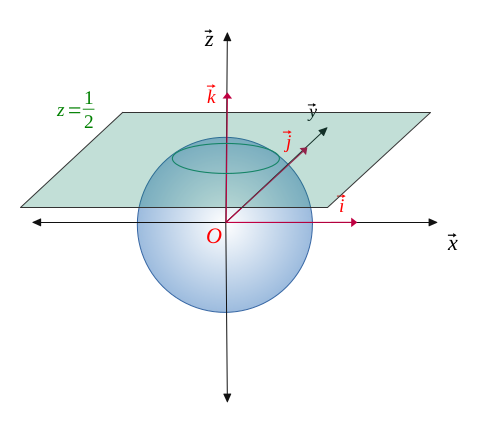
 Back to top